
 Fact checked


We may receive compensation from our partners for placement of their products or services, which helps to maintain our site. We may also receive compensation if you click on certain links posted on our site. While compensation arrangements may affect the order, position or placement of product information, it doesn’t influence our assessment of those products.
The UK labour market has changed quickly as digital platforms replace many traditional agency roles. Freelancing marketplaces now take a growing share of project work, and Upwork has become one of the leading names. It is listed on the Nasdaq exchange in New York under the ticker “UPWK”.
For UK investors, Upwork stock offers exposure to the expanding gig economy. Buying American shares, however, is not as straightforward as purchasing familiar names such as Tesco or Lloyds. It involves different rules, costs, and trading platforms. This article explains how British beginners can approach Upwork, what to weigh up before buying, and which brokers provide reliable access.
Why Upwork Has Caught Investors’ Attention
Upwork connects businesses with freelancers in areas from software development to creative services. Its model benefits from the shift towards remote and contract-based work.
The company competes with platforms such as Fiverr but has built credibility with larger organisations. For investors, the draw is exposure to the growing gig economy as more firms scale back permanent staff.
Risks remain. Revenue depends on transaction volumes, competition is intense, and the share price has shown sharp swings. Upwork may suit a diversified portfolio, but is less likely to serve as a core holding.
Accessing US Stocks from the UK
Since Upwork trades on the Nasdaq, UK investors need a broker with access to American markets. Not every platform offers this, so choosing the right provider is important.
- Regulation: Pick a broker authorised by the Financial Conduct Authority (FCA) to ensure investor protection.
- Currency conversion: Trades settle in US dollars. Sterling deposits are converted automatically, but fees vary and should be checked.
- Ownership type: Some brokers offer only contracts for difference, while others allow direct share ownership. CFDs are suited for short-term traders, whereas long-term investors may prefer traditional trading.
Step-by-Step: Buying Upwork Stock in the UK
For UK investors, buying an American share such as Upwork is much like trading local equities, with a few extra steps to consider.
Not all UK platforms offer Nasdaq trading. Selecting one that does is essential. Later in this article, we highlight three suitable options for beginners.
Brokers will ask for proof of identity and address. Once approved, you can fund the account in sterling. Most platforms convert into US dollars automatically, though some, such as Interactive Brokers, allow multi-currency balances to reduce costs.
In the trading dashboard, enter “UPWK” to find Upwork’s listing. You can then buy at the market price or set a limit order at a level you prefer.
Many beginners start with a small position. Some brokers also support fractional shares, making it possible to invest modest sums while learning.
Check all charges before confirming, including conversion fees, commissions, or spreads on CFDs. Once executed, the position will appear in your portfolio.
Tax Considerations for UK Investors
Owning US-listed shares brings a few extra tax points for UK investors.
- Withholding Tax on Dividends: US companies deduct 30 per cent from dividends paid to overseas shareholders. UK residents can usually reduce this to 15 percent by filing a W-8BEN form with their broker.
- Capital Gains Tax: Profits from selling US shares are subject to UK capital gains tax in the same way as domestic equities. Some brokers let you hold US stocks in an ISA or SIPP, which shields gains from tax within annual limits.
- Why Planning Matters: Even modest dividends can be eroded by unnecessary tax. Completing the right forms and knowing what your broker provides helps keep costs down and avoid problems later.
Best Brokers for Buying Upwork Stock in the UK
Some UK trading apps primarily focus on domestic shares, but several FCA-regulated brokers give straightforward access to US markets. For those looking to buy Upwork stock, these three platforms stand out for their reliability, features, and track record.
1. eToro

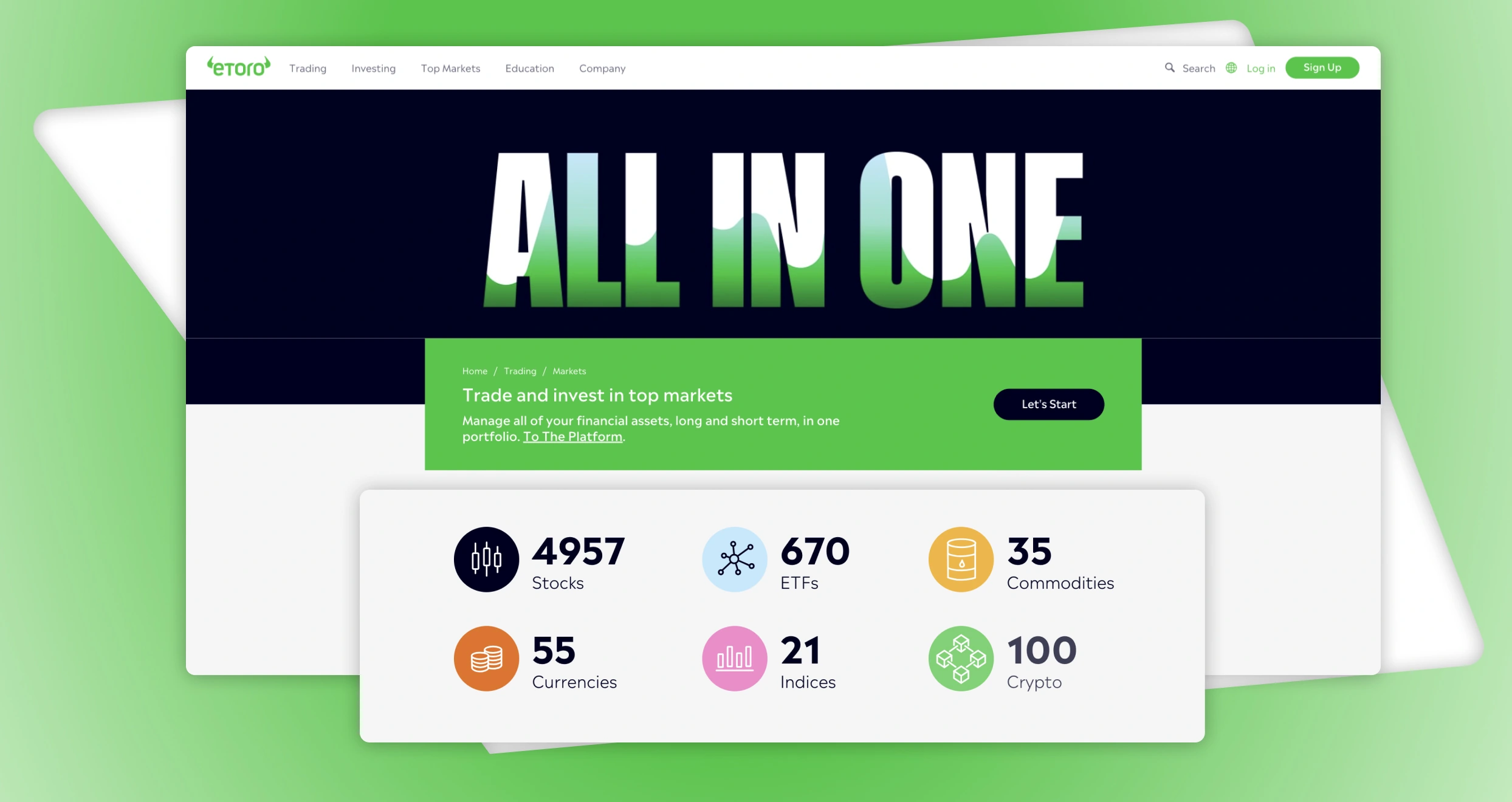
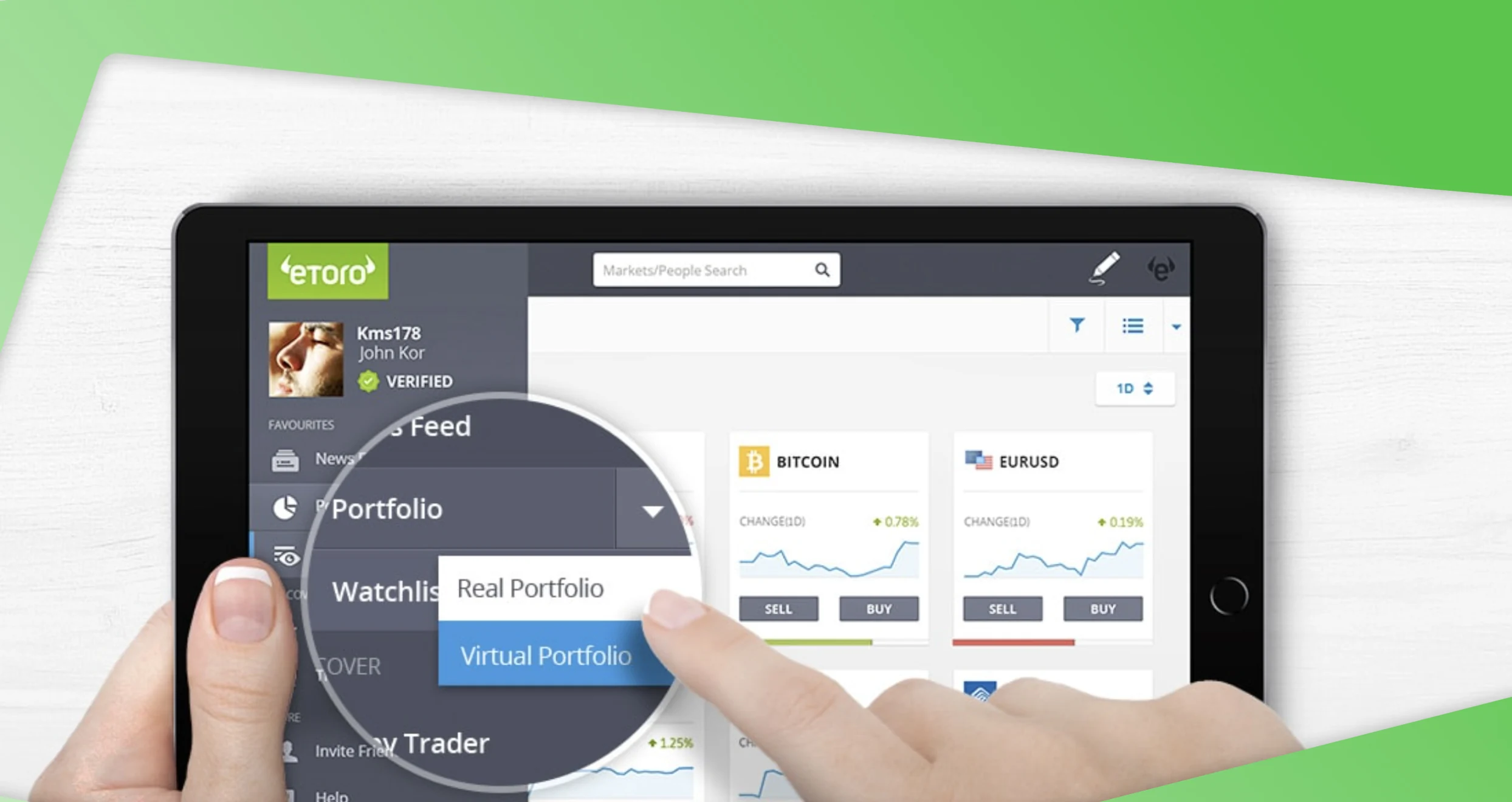

eToro is one of the most recognisable names in retail trading. Founded in 2007, it has built a reputation for making global markets accessible through a simple interface. The platform offers US, UK, and European shares, plus ETFs, commodities, and cryptocurrencies. Beginners are drawn to its commission-free model on US stocks and the “copy trading” feature, which allows them to follow experienced investors.
Account setup is quick, and FCA regulation adds security, but there are trade-offs. Sterling deposits are converted into dollars, and the fees can add up with frequent trading. Research tools are also more limited than on specialist platforms. Even so, for a first step into international shares like Upwork, eToro provides an accessible starting point.

✔5000+ financial instruments
✔Cost-free deposits




Pros
- FCA-regulated with an established global presence.
- Commission-free share dealing on US stocks.
- Social trading options for beginners.
Cons
- Currency conversion fees on sterling deposits.
- Limited depth of research and analysis tools.
If there’s anything that can eat away at your profit margins, it’s unnecessary costs. Thankfully, eToro fees UK are reasonable and pocket-friendly. We acquired a new account without paying a single cent, which was quite a relief. We also noticed that you can enjoy free deposits by using USD. That said, eToro supports many other currencies, including GBP, EUR, and RMB.
You will incur conversion fees if you use any currency other than USD. And if you use any currency that eToro doesn’t support, you must pay conversion fees to your payment provider. The exact conversion fees you may incur at any moment will depend on various factors, including your preferred currency and payment method.
Please note that eToro subjects each withdrawal request to a £5 fee. The platform uses this money to pay expenses arising from international money transfers. Most importantly, you can’t withdraw less than £30 from the eToro trading platform.
While depositing money into our account, we noticed that eToro has strict minimum deposit requirements. Britons using this platform have to deposit at least £100 the first time. Afterwards, you can fund your account with as little as £10, depending on your preferred payment method.
Commission-wise, eToro is very friendly to people who trade ETFs or invest in real stocks since the broker charges 0% for these assets. On the other hand, if you buy or sell crypto on this platform, expect to pay a 1% fee. CFD trading also attracts variable spreads depending on the involved instruments. For instance, the spreads for currencies and commodities start from 1 pip and 2 pips, respectively.
Not to forget, eToro charges a £10 monthly inactivity fee that kicks in after 12 months of dormancy.
2. Plus500
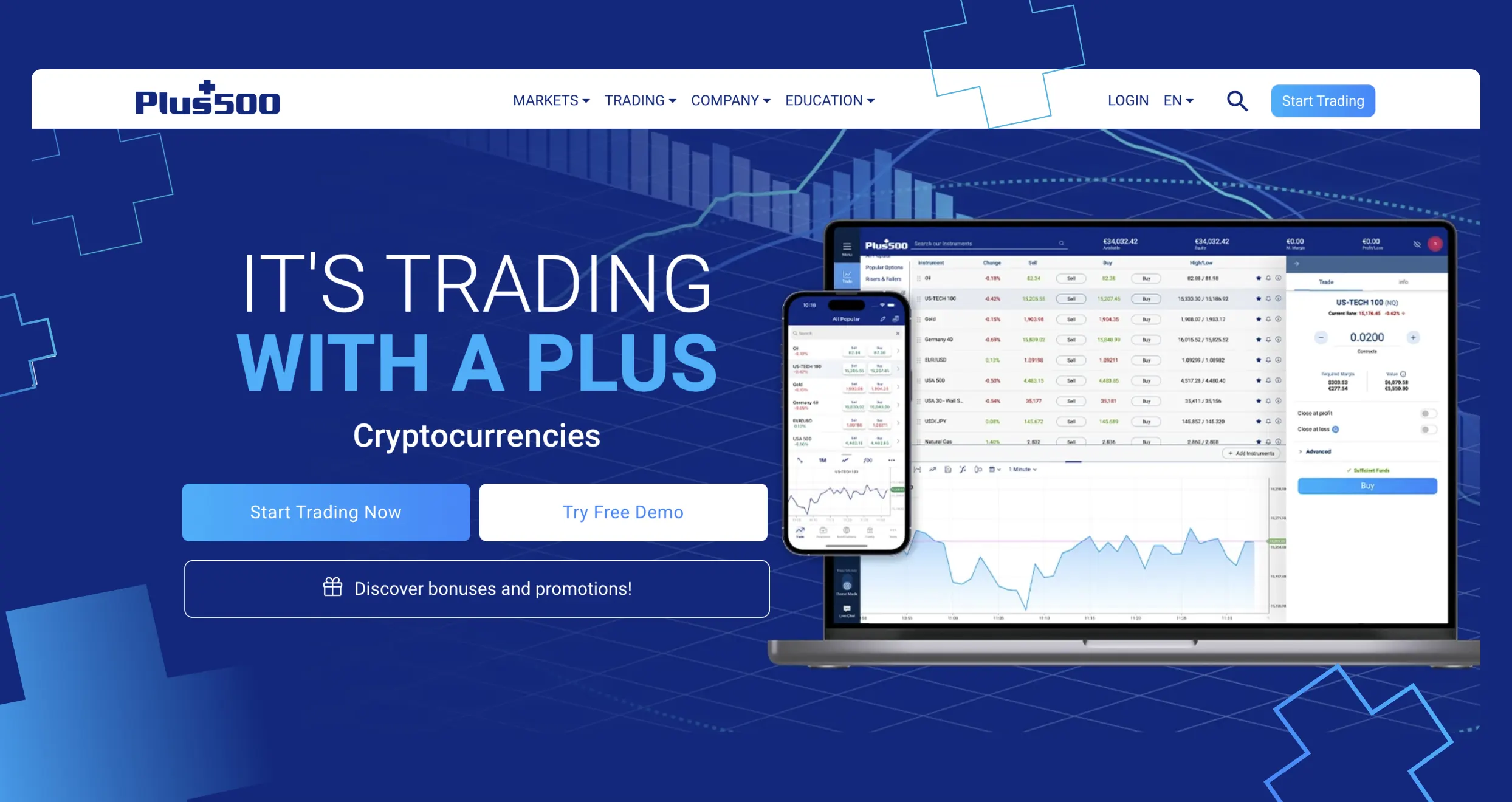
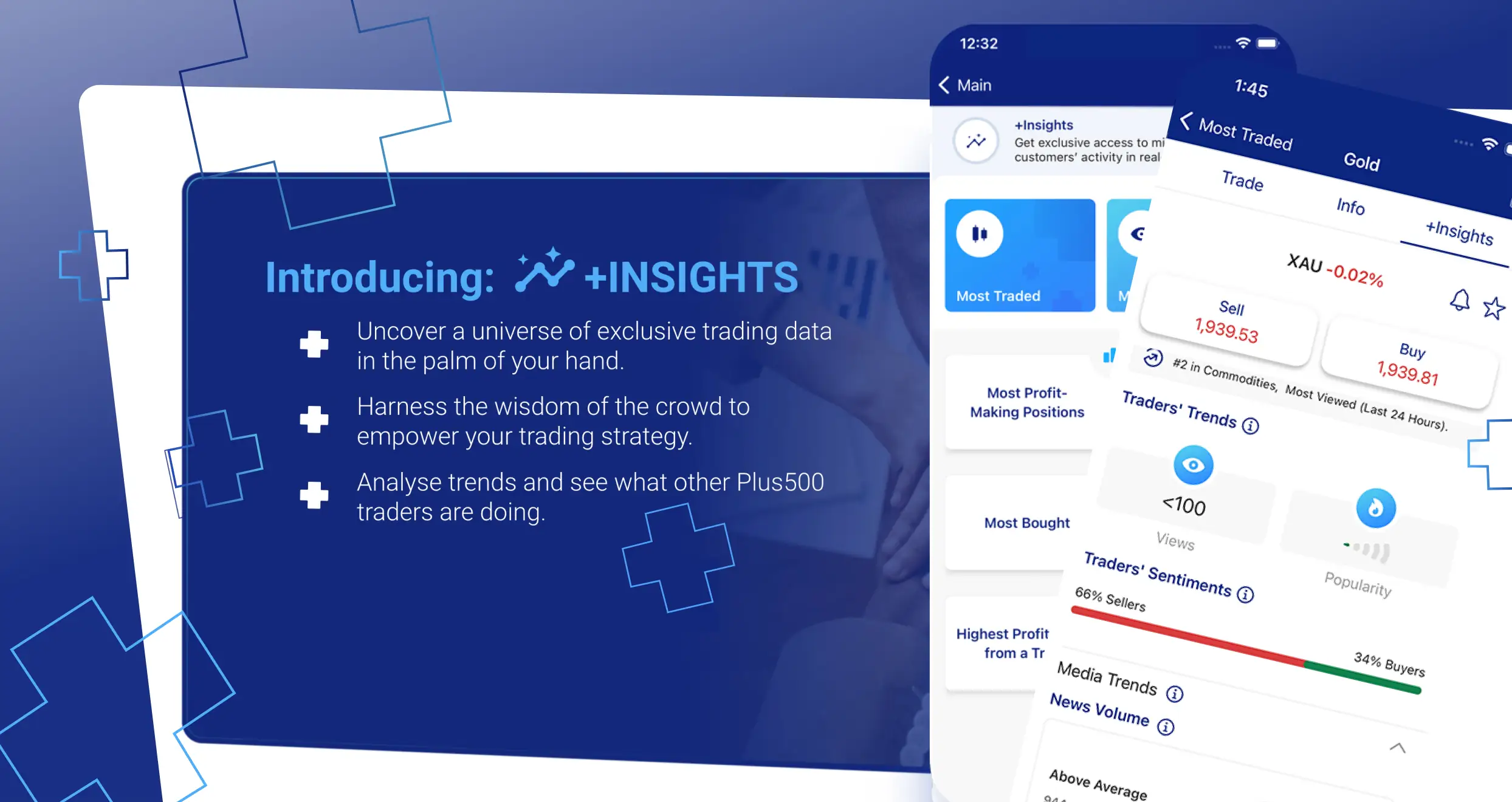


Plus500 is one of the longest-running online trading brands, best known for its contracts for difference. Listed on the London Stock Exchange, it serves millions of clients worldwide. Its platform is designed for speed and simplicity, giving traders access to CFDs on US, UK, and global shares, along with forex, indices, and commodities.
While its roots are in leveraged products, Plus500 has expanded to include listed shares. The interface is straightforward, even for beginners, and the broker has a solid reputation for reliability. However, it remains more suited to active traders than long-term investors, and its educational resources are less extensive than those of some competitors.

✔User-friendly interface
✔Zero deposit and withdrawal fees
Pros
- Well-established and publicly listed company with global reach.
- Wide selection of CFDs and shares across major markets.
- Platform design is straightforward and quick to navigate.
Cons
- Greater focus on CFDs than on traditional share ownership.
- Limited education and research resources.
Brokers need to generate revenue and cover operating costs. That’s why many have fees and commissions. Sadly, high charges can undermine your profitability in the long run. That’s why looking for an affordable service provider is necessary.
With that in mind, we evaluated Plus500 fees UK. The process was easy since this broker values transparency. Our team was impressed by the fact that the trading platform doesn’t charge a dime for most services. First, opening an account is free. Deposits and withdrawals also attract zero charges. Furthermore, the broker offers free live CFD prices and dynamic charts. But note that the Plus500 minimum deposit UK is $50.
Plus500 primary source of compensation is the spread. While trading with this platform, you’ll have to cover the spread whenever you open a position. Your costs will depend on various factors, including your preferred instrument and current market conditions.
This broker also charges overnight funding and currency conversion fees. The former fee kicks in whenever you keep a position open overnight. On the other hand, you have to cover currency conversion fees whenever you interact with any currency besides your account’s base currency. Lastly, dormant Plus500 accounts attract a £10 monthly inactivity fee.
3. IG Markets
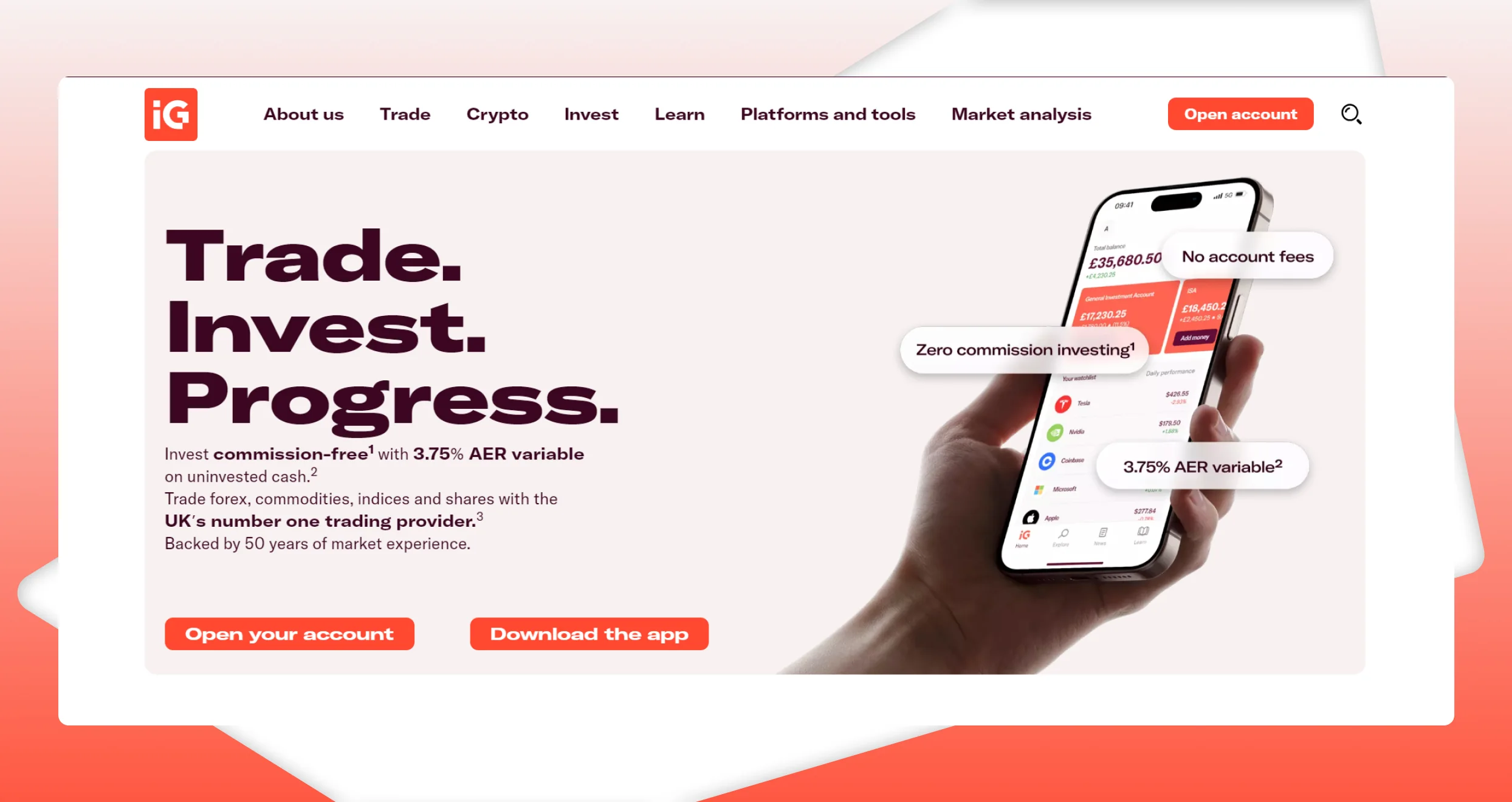
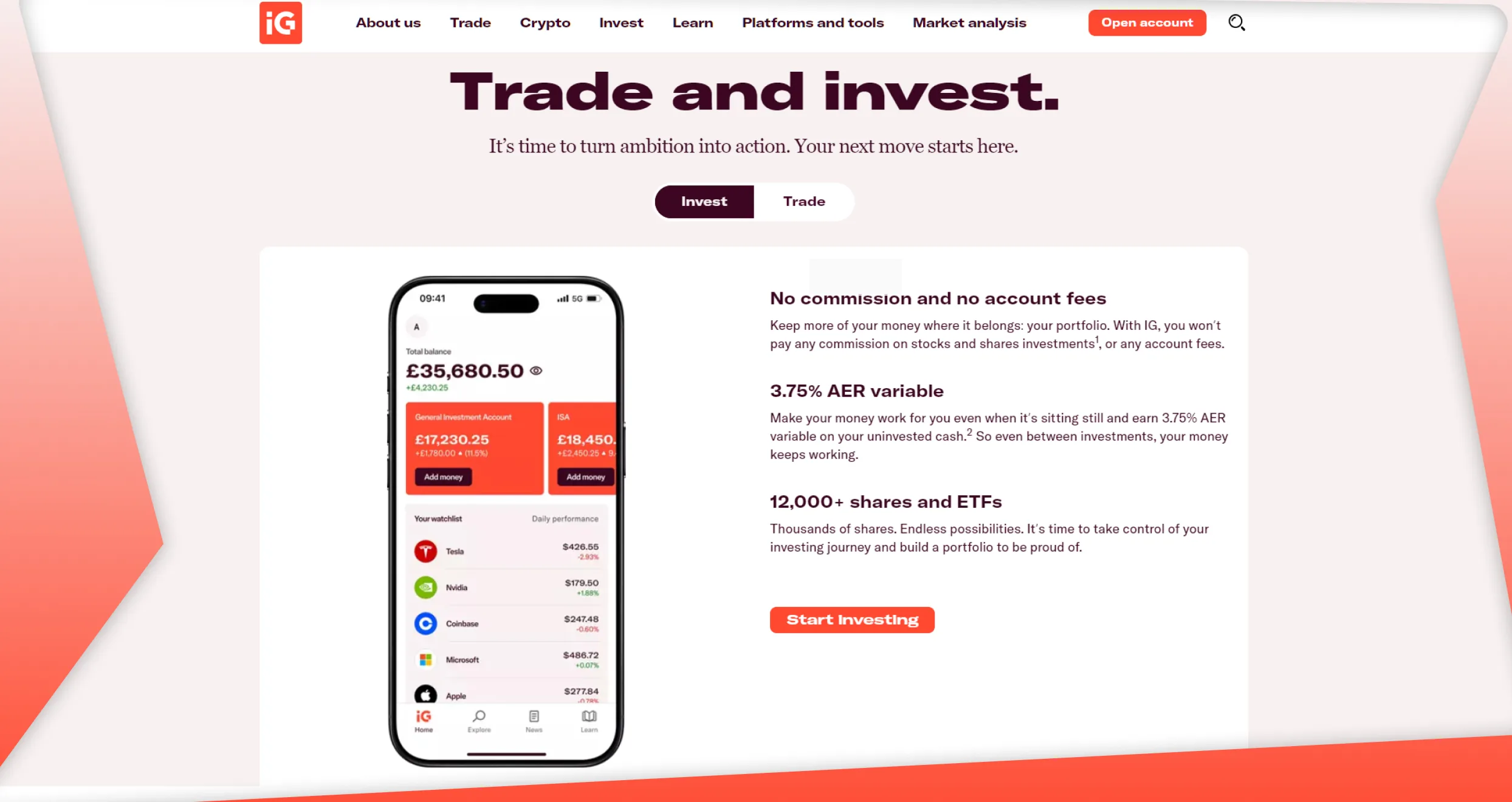
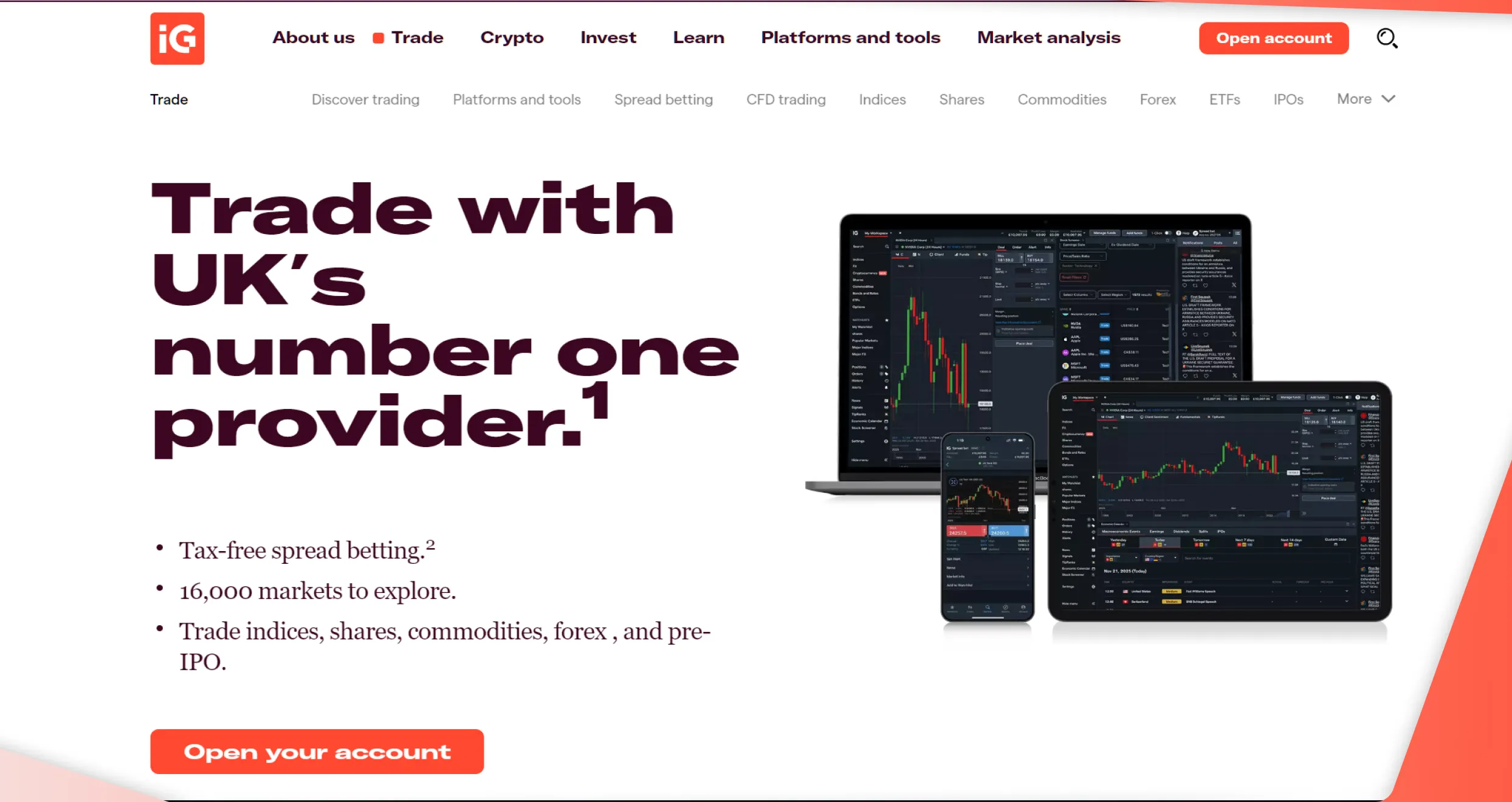
IG has been a cornerstone of the UK trading scene since the 1970s and is one of the largest providers of retail trading services worldwide. Its platform offers both CFD trading and direct share dealing, giving investors flexibility to match their strategy. IG is known for its professional-grade tools, from advanced charting and real-time data to extensive research from analysts and financial news providers.
For those who want a detailed analysis alongside access to international shares like Upwork, IG is a strong choice. The platform has a long-standing reputation for stability and oversight, though its complexity may pose a challenge for beginners. Costs can also be higher than on commission-free apps, especially for smaller trades.

✔Zero minimum deposit requirements
✔17,000+ available products
Pros
- Long history and strong reputation under FCA regulation.
- Access to both CFDs and direct share ownership.
- Advanced research, data, and analysis tools.
Cons
- Minimum deposit can be higher than on budget apps.
- Fee structure is more detailed and can be harder to compare at a glance.
Opening an IG Markets account doesn’t cost a dime. Moreover, this broker has no minimum deposit, so you don’t have to worry about compromising your budget. You can also enjoy significant savings by trading with IG Markets since it offers tight spreads, starting from 0.1 points on commodities and 0.6 points on popular currency pairs.
With that in mind, IG Markets charges overnight funding for cash CFD positions and daily funded bets (DFBs) that remain open past 10 pm UK time. The broker also requires traders to cover a small guaranteed stop fee. The fee kicks in every time the guaranteed stop feature is triggered. You should also expect to incur additional when shorting stocks and augmenting your trading experiences with premium services like live data streams.
Luckily, deposits and withdrawals are free on IG Markets. The broker only requires traders to pay a 0.5% standard currency conversion fee. Furthermore, the platform has zero inactivity fees, though your account will be terminated if it remains dormant for 24 consecutive months.
Risks and Rewards of Buying Upwork Stock
Upwork offers both potential and uncertainty. On the positive side, it provides exposure to the growing gig economy, which can diversify a portfolio otherwise dominated by sectors such as banking or energy. For some investors, particularly younger ones, holding shares in a company shaping the modern workplace can be attractive.
The risks are equally clear. Revenues depend heavily on freelance demand, and strong competition could limit growth if rivals cut fees or gain market share. The stock has also shown significant volatility, which may unsettle those used to steadier FTSE 100 names.
For most investors, Upwork is better treated as a small satellite position within a wider global equities portfolio rather than a core holding.
FAQs
That depends on your tolerance for risk. Upwork gives exposure to the freelance economy but is more volatile than established companies. For cautious investors it may work better as a small satellite holding rather than a central part of a portfolio.
No. Most UK brokers accept sterling and convert it automatically when you trade US shares. Be aware that conversion fees vary by platform and can affect returns over time.
Some brokers allow US shares to be placed in a Stocks and Shares ISA, which protects gains from UK capital gains tax. US withholding tax on dividends still applies, usually at 15 per cent once you submit a W-8BEN form.
Upwork focuses on linking businesses with freelance professionals rather than consumers. Its revenue depends directly on project volumes, which makes it more cyclical but closely tied to changes in workplace demand.
Final Thoughts
For UK investors, buying Upwork stock is straightforward with the right broker. The key is to factor in fees, conversion costs, and tax treatment, then decide how this type of growth share fits alongside steadier holdings.
For many beginners, owning a US-listed company marks a significant step in building confidence as an investor. Whether Upwork proves to be a lasting success is uncertain, but the process of assessing it, weighing risks, and understanding the mechanics of cross-border investing is valuable in itself.