





Yulia Pavliuk is a financial content writer with a background in language, education, and clear communication. She creates SEO-friendly articles that make complex finance topics like ETFs and forex signals clear and accessible, with a strong focus on UK audiences.

 Fact checked
Advertising Disclosure
We may receive compensation from our partners for placement of their products or services, which helps to maintain our site. We may also receive compensation if you click on certain links posted on our site. While compensation arrangements may affect the order, position or placement of product information, it doesn’t influence our assessment of those products.
The UK economy is losing momentum. Growth has stalled for much of the year, consumer spending is soft, and business surveys point to a slowdown that is becoming harder to dismiss. With living costs still high and interest rates acting as a drag, many households and investors are asking the same question: Is the UK heading for recession?
The country’s stock market is reacting to the gloomy mood. The main index of UK company shares, the FTSE 100, is moving wildly. This is because investors are worried about stubborn inflation, falling retail demand, and the risk that higher borrowing costs could push the economy into a downturn.
In This Guide
Best Brokers to Trade
1. eToro

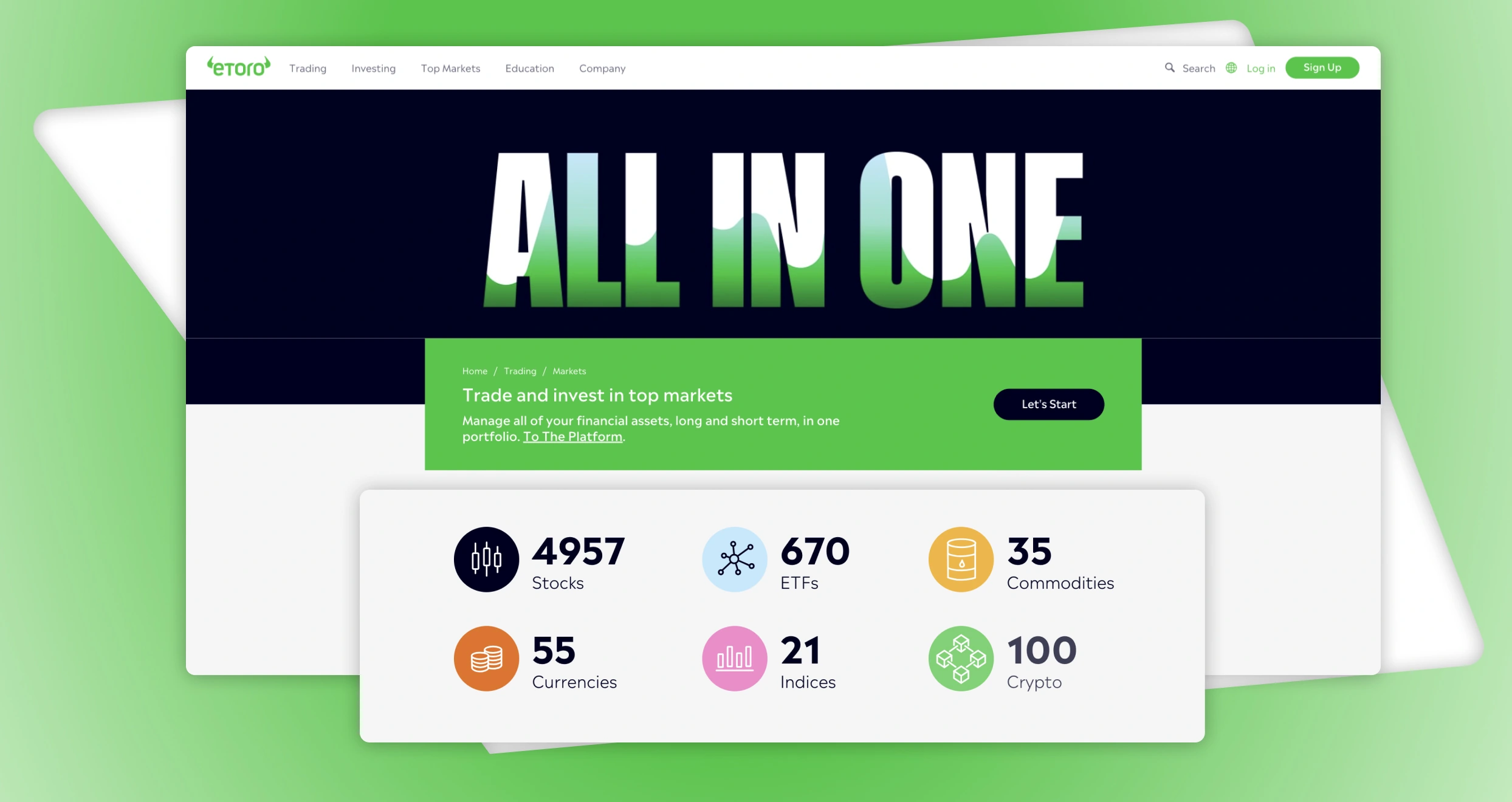
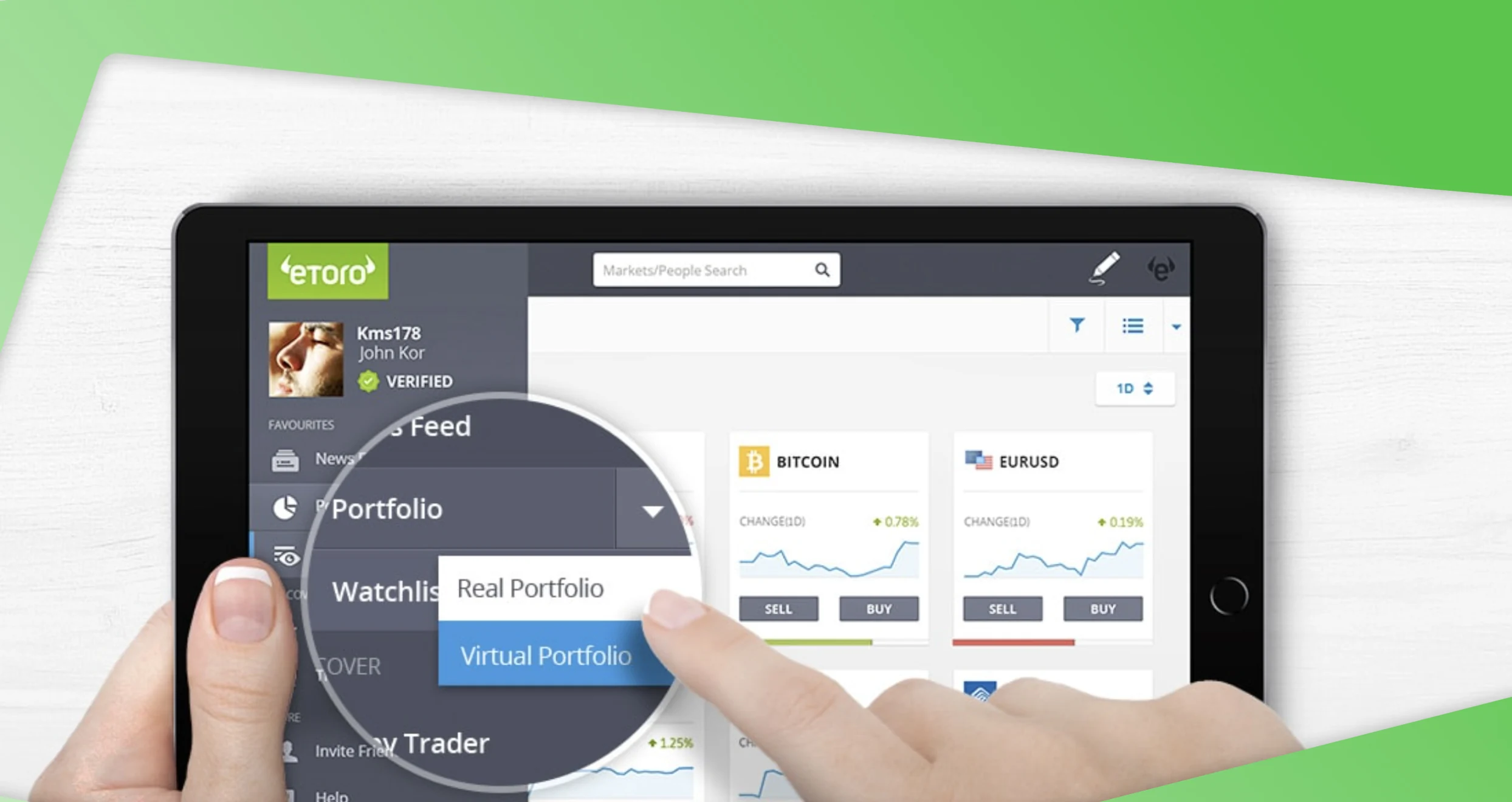

A recession rarely hits every asset class the same way, and eToro’s mix of commission-free stocks, ETFs and CFDs makes it straightforward to spread a portfolio across sectors rather than concentrate risk in one place. Minimum deposit is £50, and GBP transactions carry no fee. Negative balance protection also caps losses at your deposited funds, useful reassurance during a genuinely volatile stretch for markets. eToro also publishes regular market commentary on macro themes affecting sentiment.
Copying an experienced investor’s allocation through CopyTrader is one option if you’re unsure where to start, and eToro’s Smart Portfolios bundle several assets into a single, professionally themed investment for anyone who’d rather not pick individual positions during volatile periods. Beyond stocks, eToro lists 11,000+ other securities for diversification.

eToro
✔5000+ financial instruments
✔Cost-free deposits
Pros & Cons
Fees
Trading Assets
Pros
- Commission-free stocks and ETFs
- Smart Portfolios for diversification
- CopyTrader platform
- £50 starting deposit
Cons
- £5 withdrawal fee from a USD wallet
- Monthly inactivity fee after 12 months
If there’s anything that can eat away at your profit margins, it’s unnecessary costs. Thankfully, eToro fees UK are reasonable and pocket-friendly. We acquired a new account without paying a single cent, which was quite a relief. We also noticed that you can enjoy free deposits by using USD. That said, eToro supports many other currencies, including GBP, EUR, and RMB.
You will incur conversion fees if you use any currency other than USD. And if you use any currency that eToro doesn’t support, you must pay conversion fees to your payment provider. The exact conversion fees you may incur at any moment will depend on various factors, including your preferred currency and payment method.
Please note that eToro subjects each withdrawal request to a £5 fee. The platform uses this money to pay expenses arising from international money transfers. Most importantly, you can’t withdraw less than £30 from the eToro trading platform.
While depositing money into our account, we noticed that eToro has strict minimum deposit requirements. Britons using this platform have to deposit at least £100 the first time. Afterwards, you can fund your account with as little as £10, depending on your preferred payment method.
Commission-wise, eToro is very friendly to people who trade ETFs or invest in real stocks since the broker charges 0% for these assets. On the other hand, if you buy or sell crypto on this platform, expect to pay a 1% fee. CFD trading also attracts variable spreads depending on the involved instruments. For instance, the spreads for currencies and commodities start from 1 pip and 2 pips, respectively.
Not to forget, eToro charges a £10 monthly inactivity fee that kicks in after 12 months of dormancy.
2. Pepperstone



A recession call is really a bet that certain markets fall, and Pepperstone’s CFDs let you short indices, shares and commodities just as easily as going long. That flexibility matters more when the broader narrative is about contraction rather than growth across the economy. Negative balance protection caps losses at your deposited funds regardless of how sharply a shorted market moves. Pepperstone also publishes regular macro commentary on rate decisions and growth data.
There’s no minimum deposit requirement, and the Razor account offers spreads from 0.0 pips plus a small commission, while Standard is commission-free from around 1.0 pip. Trading runs through MetaTrader 4, MetaTrader 5, cTrader or TradingView, with spread betting available tax-free and 2,700+ assets for diversification.

Pepperstone
✔24/7 customer support
✔No inactivity fees
Pros & Cons
Fees
Trading Assets
Pros
- Ability to short markets as easily as going long
- No minimum deposit
- Choice of four trading platforms
- Tax-free spread betting available
Cons
- Commission applies on the Razor account
- No real share ownership, CFDs only
After evaluating Pepperstone, we opened a trading account for conducting extensive tests. The process was quick and easy.
But what impressed us most was the Pepperstone minimum deposit requirement. This platform has no minimum deposit, which makes it ideal for low-budget and high-budget traders. If you are a beginner, joining this broker is advisable since you can start with a low amount and increase your stakes with time. To top it off, Pepperstone supports free deposits and withdrawals. This broker allows you to use diverse payment methods for free, from Visa debit and credit cards to PayPal and domestic bank transfers.
When it comes to spreads and commissions, Pepperstone is very cost-friendly. You can open a Razor account with this broker and enjoy 20 commission-free trades. Pepperstone’s Standard accounts also have zero commissions. On the other hand, spreads start from as low as 0.0 pips for forex pairs like EUR/USD and 0.5 for commodities like XAUUSD.
Finally, unlike most of its peers, Pepperstone charges zero inactivity fees. However, any positions you hold overnight with this platform are subject to swap rates. Visit Pepperstone’s pricing page for a detailed account of how this broker calculated swap rates for different financial instruments.
3. Capital.com

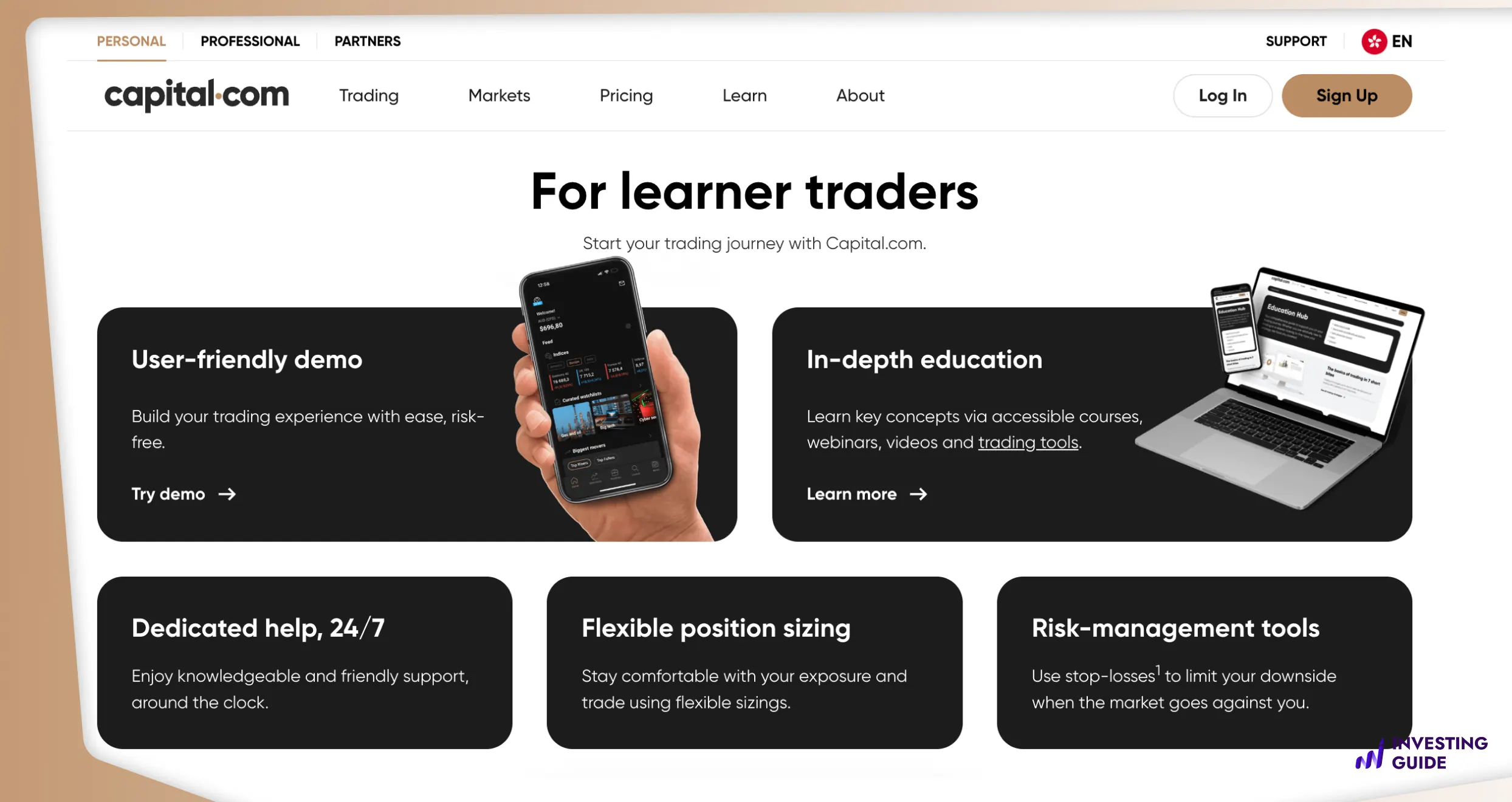

Hedging a recession call often means trading outside your usual handful of stocks, and Capital.com‘s 5,500+ CFD and spread betting markets across forex, indices, commodities and shares give you the range to do that from one account. 0% commission keeps the cost of testing a view manageable. Retail leverage on CFDs is capped at 1:30 under FCA rules, which limits how far a small deposit can be stretched across multiple hedges at once.
A £20 minimum deposit gets you started, with spreads from around 0.6 pips on major markets and no deposit or withdrawal fees. The free Investmate app is useful if hedging or shorting are new concepts, and trading runs through Capital.com’s own platform, MT4 or TradingView, with 24/7 support. Guaranteed stop-loss orders are also available at an extra cost for capping downside on any single hedge.

Capital.com
✔FCA-regulated
✔24/7 customer support
Pros & Cons
Fees
Trading Assets
Pros
- 5,500+ CFD and spread betting markets
- £20 minimum deposit
- 0% commission trading
- 24/7 support service
Cons
- No real share ownership, CFDs only
- Overnight financing applies on open positions
| Type | Fee |
|---|---|
| Minimum Deposit | £20 |
| Commission/Spreads | Free commissions, with Capital.com spreads from 0.0006 pips |
| Overnight Funding | Yes, except for the 1X account |
| Currency Conversions | £0 |
| Guaranteed Stop-Loss Orders | Yes |
| Inactivity | £10 per month after 12 months of inactivity |
| Deposits and Withdrawals | £0 |
What is the Meaning of Recession?
A recession usually means two straight quarters of falling GDP. GDP tracks the value of everything produced in the economy. When it drops for a sustained period, it signals weaker business activity, fewer new jobs, and lower confidence.
The UK is not in a recession today, but the warning signs are clear. Output across services, manufacturing, and construction has slipped several times this year. The Bank of England’s own data shows an economy barely growing. The key question is whether this slow patch deepens into a full contraction.
How Likely is a UK Recession?
The risk of a UK recession has grown. Economic growth has been close to zero since early 2024. When an economy is this fragile, even small shocks can push it into reverse.
Higher interest rates
The Bank of England has kept rates at their highest level in more than fifteen years. Mortgage costs have risen sharply. Credit is expensive for households and businesses. Many homeowners coming off fixed deals from 2021 and 2022 are facing large increases in their monthly payments. This continues to drain spending power from the wider economy.
Stretched consumers
Inflation has fallen but is still above the 2 percent target. Food prices, energy bills, and rents remain high. Wage growth is slowing. Many families entered 2026 with limited savings, so even modest price rises now feel heavier. This puts pressure on everyday spending and reduces confidence.
Weak investment
Businesses are delaying major projects and holding back on growth plans. Surveys across manufacturing and services show weaker order books and lower demand. Economists warn that slow investment today reduces productivity and limits future growth. It creates a cycle that becomes harder to break.
Global risks
The global backdrop is not helping. Growth in Europe has cooled, and demand for UK exports has softened. Trade tensions between major economies continue to rise. New US tariffs and disruption on key shipping routes have added fresh uncertainty.
One senior economist at a large British investment firm said the UK is “perilously close” to recession. They warned that a small shock, such as a rise in oil prices or a fall in consumer spending, could push quarterly GDP into contraction.
Are We Already in a UK Recession?
Not yet, but the margin is thin. Monthly GDP data has zig-zagged all year, with small gains followed by declines. Performance varies by sector. Travel and hospitality have held up better than expected, while manufacturing and construction have been weak. Industrial action and NHS backlogs have added extra pressure.
The Bank of England expects low growth to continue until rate cuts take effect. It has also highlighted a cooling labour market. Vacancies have fallen sharply from their peak. Wage growth is slowing. These are typical early signs of weakening demand.
Could the UK Economy Collapse?
A collapse is not on the cards. Britain has a large, diverse economy, a stable financial system, and one of the world’s most trusted currencies. But a recession is possible. The bigger risk is a long, slow downturn that leaves households feeling poorer and discourages firms from investing.
Analysts point to the UK’s long-standing challenges, including weak productivity and a tight labour market. Growth has been slow since the pandemic. The tax burden is the highest in decades. Combined with high interest rates, these factors make the economy less resilient to shocks.
What Would a Recession Mean for Households?
A recession would hit household finances on several fronts. Wage growth would slow and unemployment would likely rise as firms cut costs. Borrowers would feel more pressure, particularly those already struggling with high mortgage or credit repayments. House prices could weaken, especially in areas where buyers are heavily leveraged.
If the Bank of England starts cutting interest rates next year, some mortgage holders may get some relief through lower monthly payments. Savers would face the opposite effect. Returns on cash accounts would fall, reducing the benefit of holding money in short-term savings.
Overall, a recession would create a tougher backdrop for families already dealing with high living costs and fragile confidence.
What Are the Risks for the Markets?
Markets would face a more volatile backdrop. Large FTSE 100 companies with global earnings may weather the storm better. Domestic stocks, such as retailers, banks, and housebuilders, are more exposed to a UK downturn.
Government borrowing may rise if tax receipts fall. That can push gilt yields higher, although expected rate cuts would pull in the opposite direction. Pension funds invested in mixed portfolios would feel the impact of both weak growth and choppy markets.
How to Invest During a Recession
Investing in a recession often comes down to stability and quality. Defensive sectors like healthcare, utilities, and consumer staples tend to prove more resilient when demand slows. Companies with strong cash flow, low debt, and reliable customer bases usually fare better.
Many investors prefer to continue regular monthly contributions to ISAs and pensions. This smooths out market swings because contributions buy more shares when prices fall and fewer when they rise. Trying to time the exact bottom is rarely effective.
A solid cash buffer also matters. Even in a recession, an emergency fund offers breathing room and reduces the need to sell investments at the wrong moment.
What Happens Next?
The next few months will shape the outlook. If inflation keeps falling and the Bank of England starts to cut rates, the recession risk may ease. But if energy prices rise again, mortgage resets move faster, or global trade weakens, the risk will increase.
For now, the UK sits in a fragile middle ground. It is not in a recession, but it is close enough that a single shock could tip it over. The hope is that confidence improves before that happens. The risk is that households and businesses struggle through another year of tight financial conditions.
Related Articles: